
Seven days. You logged everything. You said no to the thing in the break room. You went for the walk you did not feel like taking.
Saturday morning, you step on the scale: up 1.4 pounds.
The feeling that follows is specific and awful — a mix of betrayal and pointlessness that has ended more weight-loss attempts than any birthday cake. So let us take it apart, because that number is not what you think it is.
You did not gain 1.4 pounds of fat
You could not have. Gaining 1.4 pounds of fat requires eating roughly 4,900 calories above your burn. In a week where you ran a deficit, that is arithmetically impossible.
What you are looking at is almost entirely water, plus the physical contents of your digestive system. Both move far more, and far faster, than fat does.
What actually moved the number
Sodium. A saltier-than-usual meal makes your body hold extra water for a day or two. One restaurant dinner can show up as two pounds the next morning and be gone by Wednesday.
Carbohydrate. Your body stores carbs as glycogen, and each gram of glycogen holds several grams of water alongside it. Eat more carbs than usual — even at a calorie deficit — and you gain water weight. This is also why low-carb diets produce that dramatic first week: it is largely water leaving, not fat.
Exercise. A hard or unfamiliar workout causes minor muscle inflammation, and your body sends fluid to repair it. Ironically, the week you finally start training is often the week the scale sticks.
Hormones. For people who menstruate, water retention across the cycle commonly swings several pounds and has nothing to do with fat.
What is still in transit. Food and fluid you have eaten but not yet processed has weight. A high-fiber day or a late dinner shows up on the morning scale as itself.
Stack a few of these and a five-pound daily swing is unremarkable. Meanwhile a genuinely excellent week of fat loss is... about one pound. The noise is bigger than the signal. That is the entire problem with daily weigh-ins.
How to read the scale properly
- Weigh under identical conditions. Same time, first thing in the morning, after the bathroom, before eating or drinking. You are removing variables, not chasing a flattering number.
- Judge by trend, not by day. Compare this week's average to last week's average. Individual mornings are weather; the average is climate.
- Expect stair-steps. Fat loss is steady but the scale is not. It commonly holds flat for ten days and then drops a pound and a half in two — the fat was leaving the whole time while water masked it.
- Weigh daily or weekly — but pick one. Daily gives you a better average if you can look at a high number without spiraling. Weekly protects your peace but is noisier per reading. Both work; know which you are.
Track the input instead
Here is the deeper fix: the scale measures an output you do not directly control. Your calorie deficit is an input you do.
You cannot decide to weigh less on Tuesday. You can decide to finish Tuesday under your TDEE. Do that consistently and the scale has no choice but to follow — on its own schedule, with all the water noise it likes.
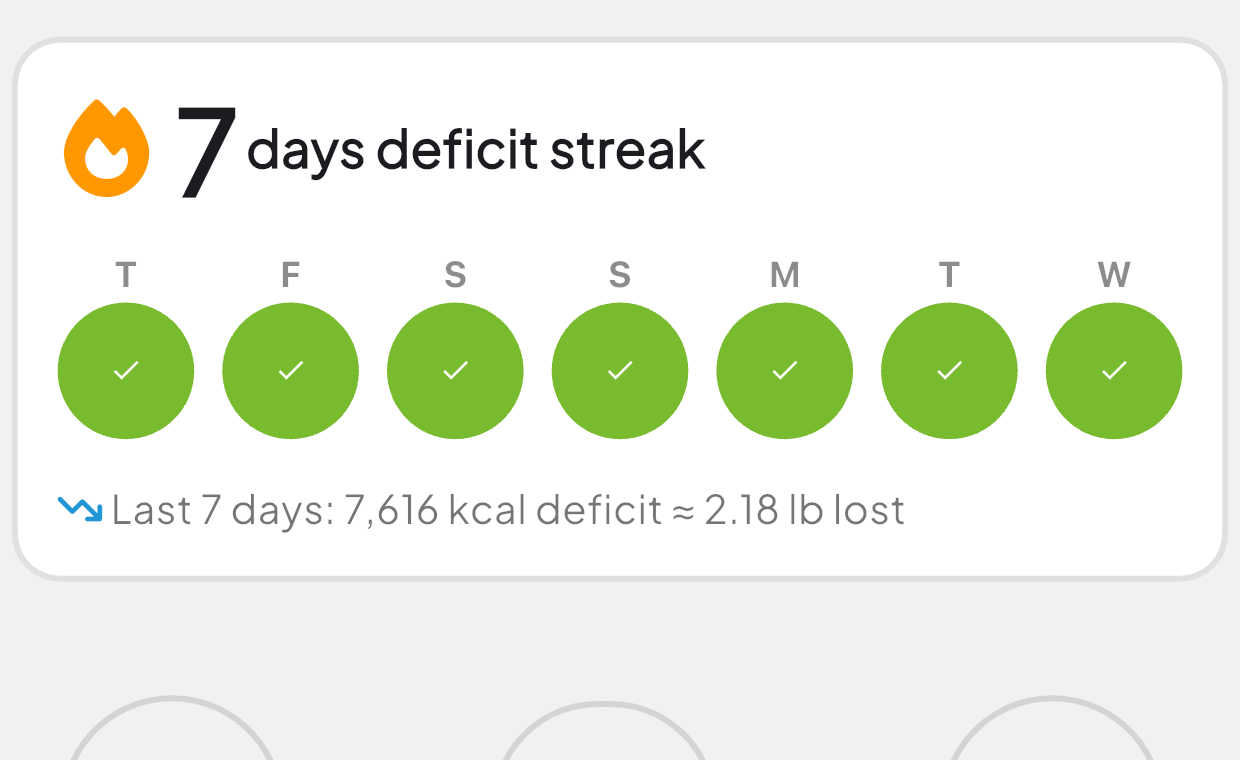
That is why Weight Loss Navigator puts a deficit streak on the dashboard. Every day under your number turns green and the streak grows. On a morning the scale is being ridiculous, you have honest evidence sitting right there: seven green days, 7,600 calories under, roughly two pounds of real progress regardless of what the display said.
The bottom line
A scale gain after a good week is almost always water, and water is temporary. Your body is not rebelling and your metabolism is not broken. Keep the deficit, keep weighing under the same conditions, and look at the trend in two weeks.
The number was never a verdict on the week. The week was a verdict on the week.
This article is general information, not medical advice. If you experience rapid or unexplained weight changes, talk to your doctor.