It is the most repeated number in weight loss: 3,500 calories equals one pound. Create a 3,500-calorie deficit and a pound disappears.
The honest answer is that it is a useful approximation that gets less accurate the longer you use it. Worth understanding both halves of that sentence.
Where the number comes from
The figure traces back to research from the 1950s estimating that a pound of body fat stores roughly 3,500 calories of energy. Burn through that stored energy and you have lost the pound.
As physics, it is reasonable. As a prediction of what your scale will do over six months, it has problems.
Why it drifts over time
The rule assumes weight loss is linear — that a 500-calorie daily deficit produces a pound a week this week, next month, and next year. Bodies do not cooperate.
You get smaller, so you burn less. This is the big one. A 240-pound body costs more to operate than a 200-pound body. Lose 40 pounds and your TDEE may drop by 200–300 calories per day. The deficit that once produced a pound a week now produces noticeably less, without you changing a thing.
You lose more than fat. Early weight loss includes water and stored carbohydrate, which is why the first week or two often looks dramatic. Later losses skew more toward fat, which is slower by the numbers.
Your body adapts. In a sustained deficit, energy expenditure tends to fall somewhat more than body-size changes alone would predict — partly from moving less without noticing it. Researchers such as Kevin Hall have modeled this in detail, and it is why the NIH's Body Weight Planner uses a dynamic model rather than flat arithmetic.
Logging is imperfect. Studies using doubly labeled water — the gold standard for measuring real energy expenditure — have repeatedly found that people underestimate their food intake, often substantially. A 500-calorie deficit on paper may be a 250-calorie deficit in reality.
So should you ignore it?
No. Ignore it and you are back to "eat less, move more," which is advice, not a plan.
The right way to hold the 3,500 rule is as a short-term planning tool, not a long-term guarantee. Over a week or two, it will land you in the right ballpark: a consistent 500-per-day deficit really does tend to produce something close to a pound a week early on. Over a year, expect the pace to slow and expect to adjust.
What it does brilliantly is make an abstract effort concrete. "I ate less today" is a feeling. "I finished 620 under, and my week is at 3,100" is a number that adds up to something you can see.
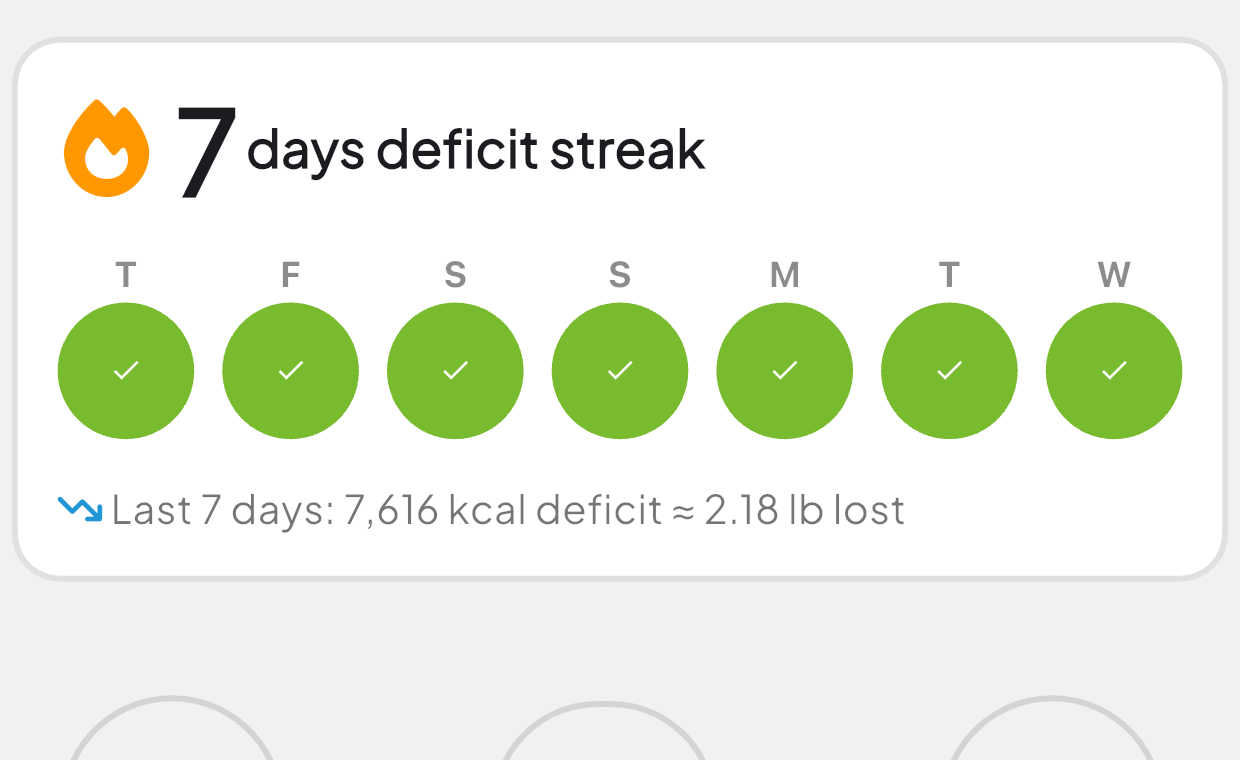
That is exactly why Weight Loss Navigator shows your last seven days as a running deficit total and converts it into approximate pounds. It is labeled as an estimate because it is one — but it turns a week of small, unglamorous decisions into visible progress.
How to use it well
- Plan with it, do not predict with it. Use 3,500 to set a target. Use the scale trend over several weeks to judge whether the target is working.
- Recalculate as you lose. Update your weight every 10–15 pounds so your TDEE follows you down. This single habit corrects most of the rule's drift.
- Expect the pace to slow. It is not failure, and it is not a broken metabolism. It is a smaller body doing less work.
- Judge by weeks, not days. Daily weight swings from water and food volume routinely exceed the actual fat change.
The bottom line
3,500 calories per pound is approximately right and precisely wrong — good enough to plan a week, not good enough to predict a year. Use it as a compass rather than a GPS, adjust as your body changes, and keep your attention on consistency.
Start with your daily number →
This article is general information, not medical advice.