
Every diet that has ever worked — keto, low fat, intermittent fasting, Weight Watchers, carnivore, vegan — worked for exactly one reason. Not the reason it advertised.
They all put you in a calorie deficit.
The definition
A calorie deficit means you consumed fewer calories than your body burned. Burn 2,200 and eat 1,700, and you are in a 500-calorie deficit for the day.
When that happens, your body still needs energy to run — so it takes the difference out of storage, primarily body fat. Do that consistently and you get smaller. That is the whole mechanism.
You need exactly two numbers:
- Calories out — your TDEE, the calories you burn in a day. Calculate it free here.
- Calories in — what you eat. This is the one you control.
Why every diet is secretly the same diet
This is worth sitting with, because it explains a lot of frustration.
Keto works because cutting an entire macronutrient removes a lot of food from your options, and you end up eating less. Intermittent fasting works because an eight-hour eating window is fewer hours to eat in. Low-fat worked because fat is calorie-dense. Portion-control plans work because, well, obviously.
None of these are magic. They are all delivery mechanisms for the same thing — and that is genuinely good news, because it means you get to pick the one you can live with. If you love bread, you do not have to do keto. If breakfast is your favorite meal, you do not have to fast. The only requirement is the deficit. How you produce it is a personal preference, not a moral question.
How big should the deficit be?
The common reference point: roughly 3,500 calories of deficit equals about one pound of fat. It is an approximation rather than a physical constant, but it is a serviceable planning tool.
Using it:
- 500 calories/day → about 1 pound per week. The classic recommendation, and sustainable for most people.
- 750 calories/day → about 1.5 pounds per week. Workable if you have a fair amount to lose.
- 1,000 calories/day → about 2 pounds per week. Generally the upper end of what is advised without medical supervision, and difficult to sustain.
Most guidance points to 1 to 2 pounds per week as a reasonable rate. Faster is not better. Aggressive deficits increase muscle loss, tank your energy, and — most importantly — get abandoned. A 400-calorie deficit you maintain for six months beats a 1,000-calorie deficit you maintain for nine days, every time.
Why the scale lies to you anyway
You will do everything right for a week and see the scale go up. This is normal and it is not fat.
Your body weight swings daily based on water retention, sodium, carbohydrate intake (each gram of stored carbohydrate holds several grams of water), hormonal cycles, digestive contents, and how hard you trained yesterday. These fluctuations easily exceed the actual fat you lost that week — which is why a perfect week can show a gain.
The fix is to stop treating any single weigh-in as a verdict. Watch the trend across weeks. Better yet, watch the thing you actually control: did you hit your deficit? That question has a clean yes-or-no answer every single day, and it never lies to you.
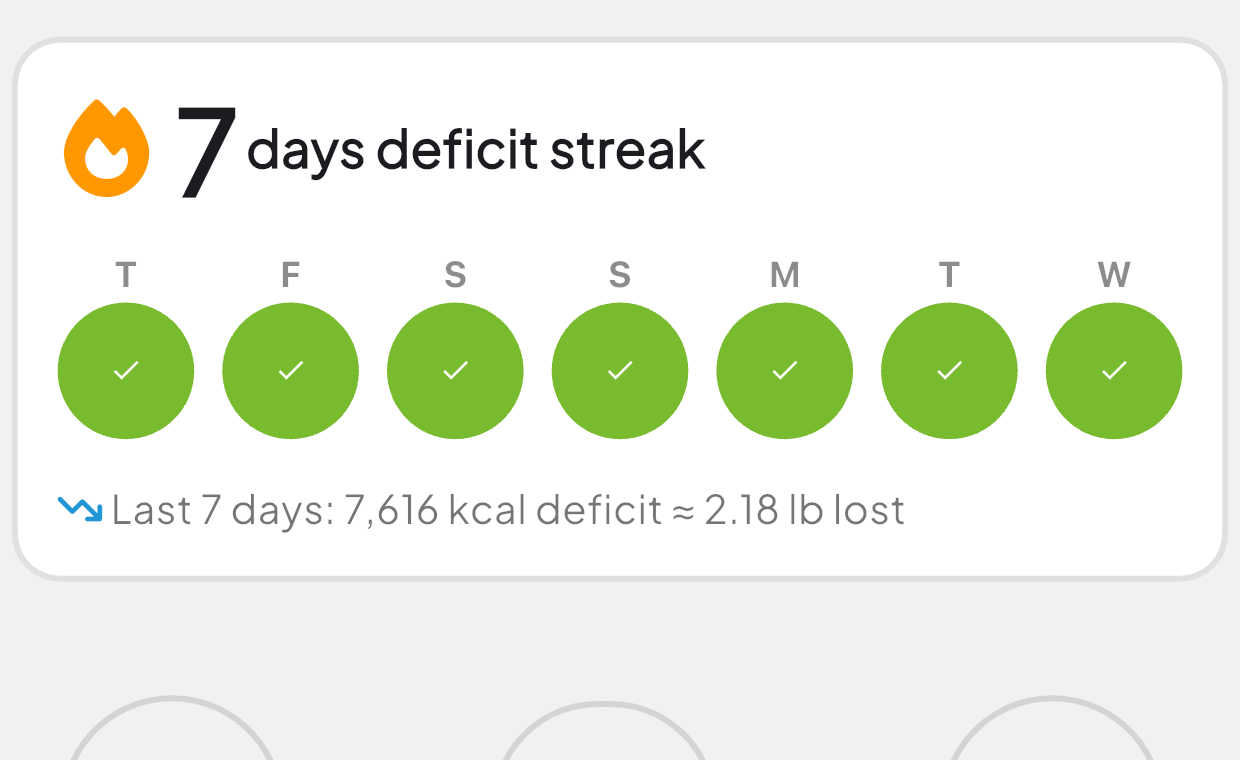
This is exactly why Weight Loss Navigator shows a deficit streak — consecutive days finishing under your TDEE — alongside a running seven-day total converted into approximate pounds. It puts your attention on the input you control instead of the noisy output.
Building your deficit without misery
Some approaches that hold up over time:
- Find your cheap swaps. Most people have two or three habits worth several hundred calories that they would not miss much — the daily specialty coffee, the soda, the after-dinner second helping. Removing one or two of those can be most of your deficit before you touch anything you love.
- Prioritize protein and volume. Protein is satiating and costs more energy to digest. High-volume foods (vegetables, broth-based soups, fruit) let you eat a satisfying amount of food for fewer calories.
- Do not try to earn it all with exercise. Exercise is excellent for health and helps preserve muscle in a deficit, but burning 500 calories takes real time and effort while eating 500 fewer is a decision. Use both, weight the diet side.
- Log everything, including the bad days. The purpose of logging is not to be perfect. It is to know your real number. A day you went 800 over is data, not failure.
The bottom line
A calorie deficit is not a diet. It is the mechanism every diet uses. Learn your TDEE, eat somewhat below it, stay consistent, and ignore the daily scale noise.
Start by finding your number →
This article is general information, not medical advice. Talk to your doctor before starting a weight loss plan, especially if you have a medical condition or take medication that affects weight or blood sugar.