The hardest part of losing weight is not any individual day. It is stringing enough ordinary days together that the arithmetic turns into a result.
That is exactly what a streak is for.
What counts as a deficit day
Simple: a day where your net calories came in under your TDEE.
Net calories means food minus workouts. Eat 1,900, burn 300 walking, and your net is 1,600. If your TDEE is 2,200, that is a deficit day and it turns green.
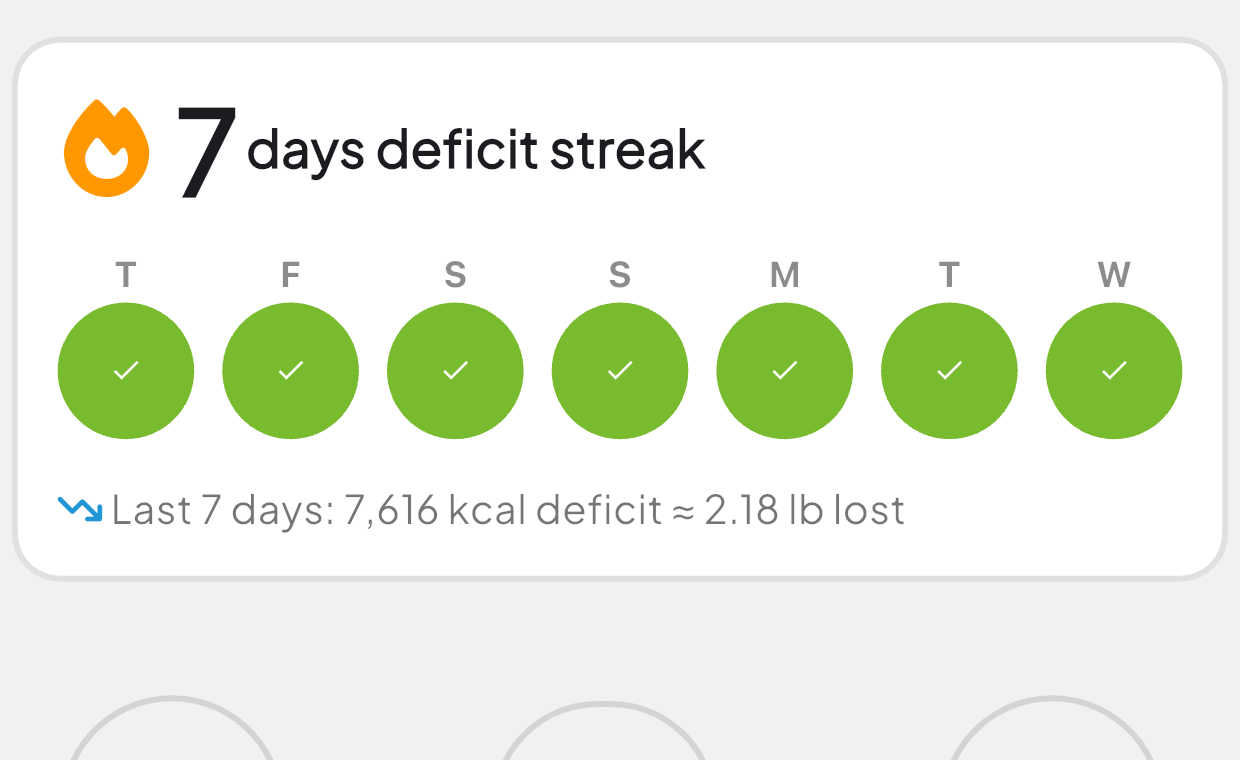
Your streak counts consecutive deficit days. Seven green circles means seven straight days under your number.
Two rules that keep it honest
A day only counts if you logged. Days with no entries do not count as deficit days — you cannot earn a streak by forgetting to eat or forgetting to track. It is a record of what you actually did.
Today never breaks your streak. This one matters. At 10am you have logged breakfast and you are technically "under" — but the day is not finished, so an incomplete today is not counted against you. If today is already in deficit, it extends the streak. If it is not, the streak simply holds until the day is over. No pressure to stop eating at 3pm to protect a number.
The seven-day total
Under the circles is the line that actually matters:
Last 7 days: 7,616 kcal deficit ≈ 2.18 lb lost
That is the sum of every deficit and surplus across the week, converted using the standard estimate of roughly 3,500 calories per pound. It is deliberately labeled as an approximation — the 3,500 rule has real limits — but it does something no scale can: it tells you what your behavior earned, independent of water weight, sodium, or hormones.
On a morning when the scale is up two pounds after a genuinely good week, this line is the honest counterweight.
Why streaks work when willpower doesn't
They move the goal to something you control. You cannot decide to weigh less tomorrow. You can decide to finish today under your number. Streaks score the input, not the output.
They give you a daily win. Weight loss offers feedback roughly weekly, and the feedback is noisy. A streak pays out every single day, which is far better suited to how motivation actually works.
They make the chain visible. There is a real reluctance to break a run of eleven. That reluctance is not willpower — it is the streak doing the work for you, at exactly the moment willpower would have failed.
They reframe a bad day correctly. Breaking a streak of eleven is not "I ruined everything." It is "I had eleven, and today I start again." That is closer to the truth, and it is far less likely to end in three weeks off.
When your streak breaks
It will. Everyone's does.
The response that matters is starting a new one tomorrow. Not a punishing 1,200-calorie day — just your normal target. Six streaks of ten days across a year beats one streak of eleven followed by four months of nothing, by an enormous margin.
The streak is a tool for consistency, not a test you can fail.
The bottom line
Weight loss is a long series of unremarkable days. A streak makes those days visible, gives you something to protect, and keeps score on the one thing you actually control.